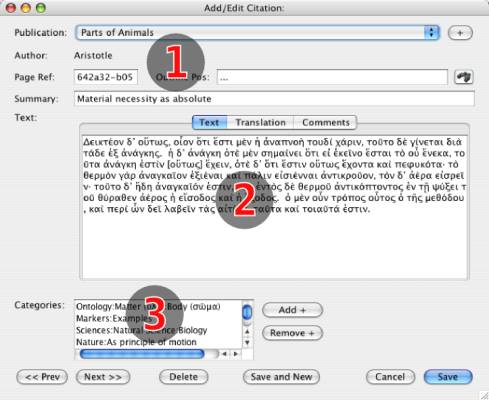
A typical "virtual notecard".
A "textual citation", in this context, is a piece of text, extracted from a book, article or other source, which is saved in a "notecard", similar to the paper notecards that are so common in academic research. The "virtual" notecard stores the name of the publication from which the text was taken, along with a page reference, a summary title, and (if desired) the place in the publication outline where the citation is from.
A completed "virtual notecard"
A typical "virtual notecard".
In the image, three important areas are marked:
Header and classification information: the publication that contains the citation, its page number (or other reference code that indicates where to find the citation within the publication), a summary title for the citation, and, if desired, its location in the publication outline.
The contents of the citation. Note that there are three tabs: you can introduce the original text in the first tab, a translation in the second, and a commentary (if desired) in the third. All of this information will be saved with the notecard, and can be exported later.
The categorization of the citation. The use of the categorization system is perhaps the most important aspect of creating a notecard. If you use categories carefully and intelligently, you will later note a major increase in your ability to find all of the citations related to a topic, or to find that "lost" citation that you entered half a year ago, but you no longer remember where you found it. You can assign as many categories as you want, and you can always create new categories on the fly if the current ones do not suffice for a given citation.